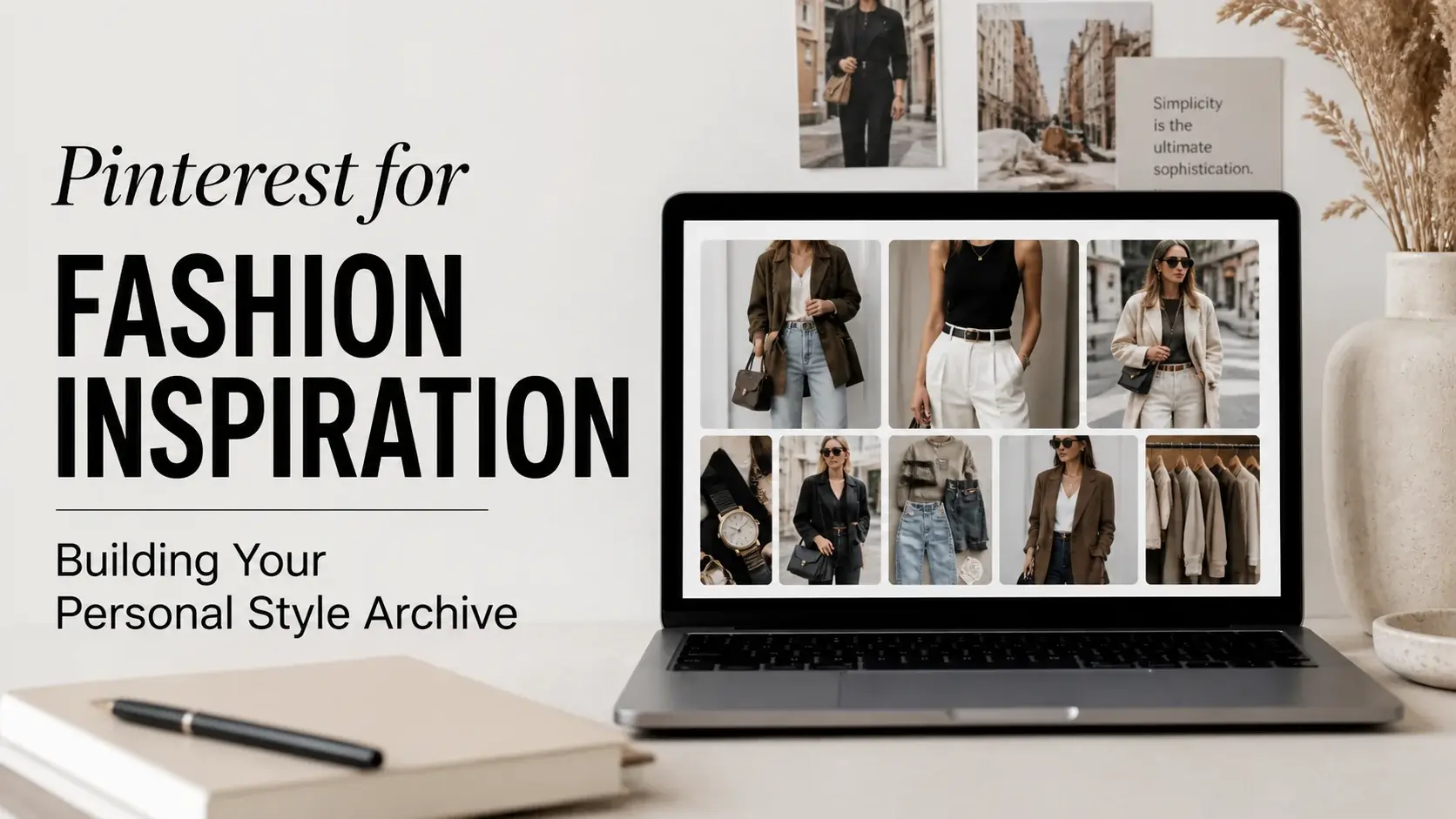
Most fashion-conscious Pinterest users have the same chaotic experience: 800 saved outfit pins across three boards, no clear sense of what they actually wear, and constant overwhelm when getting dressed each morning. The platform that should clarify your style instead muddies it.
This isn’t a Pinterest problem. It’s a curation problem. With deliberate organization, Pinterest becomes a powerful tool for understanding your authentic style, building a wardrobe that works, and getting dressed with intention rather than confusion.
This guide walks through the personal style archive workflow that actually clarifies — from initial exploration through ongoing maintenance.
Why Pinterest Beats Other Style Resources
Fashion inspiration lives across many platforms, but Pinterest has unique advantages for personal style development:
Search-driven discovery. Looking for “minimalist autumn outfits” gives you exactly that, not whatever the algorithm decides to show. You’re in control of what you see.
Persistent inspiration. A pin from 2019 about wide-leg trousers is still findable when wide-leg trousers are back in style. Instagram’s feed-driven nature loses content after weeks; Pinterest preserves it for years.
Aesthetic isolation. You can study one specific aesthetic deeply (90s grunge, Parisian minimalism, dark academia) without the algorithm constantly pulling you toward whatever’s trending.
Diverse body types and ages. Pinterest’s broader user base means you find style inspiration on people who actually look like you, not just the narrow range Instagram and TikTok algorithms favor.
Free and unlimited. Subscription-based style services can run $50-200/month. Pinterest costs nothing.
Phase 1: Exploration (Discover Your Actual Aesthetic)
Most people use Pinterest fashion casually — saving anything pretty without thinking about whether it suits them. This produces sprawling boards that don’t clarify anything.
The deliberate approach starts with exploration:
Cast a Wide Net
Create temporary “exploration” boards for each aesthetic you’re curious about:
- Minimalist Style
- Bohemian Looks
- Classic Tailoring
- Streetwear
- Romantic/Feminine
- Avant-garde
Pin 50-100 outfits to each. The goal isn’t curation yet — it’s discovery. Which boards feel like you even when nobody’s looking?
Notice Your Actual Patterns
After two weeks of exploratory pinning, review each board. Which ones do you keep returning to? Which feel forced or aspirational? Which contain pins of outfits you’d actually wear?
The aesthetic that wins isn’t the most beautiful — it’s the most you. There’s a difference between admiring something and identifying with it.
Identify Crossover
Most people don’t fit cleanly into one aesthetic. You might be 60% minimalist with a 30% bohemian streak and a 10% love of unexpected statement pieces. That hybrid is your style — own it rather than trying to fit a single label.
Phase 2: Curation (Build Your Personal Style Reference)
Once you’ve identified your aesthetic, build a tighter reference library.
Create Your Core Boards
Replace exploratory boards with curated ones:
- My Style (the strongest 50-75 pins that represent your aesthetic)
- Outfit Combinations (specific complete outfits you’d wear)
- Wardrobe Building Blocks (key pieces you want or have)
- Color Palette (colors that work for you)
- Outfit Formulas (proven combinations like “wide trouser + fitted top + statement shoe”)
Each board should have under 100 pins. Above that, you can’t process it meaningfully.
Apply Honest Filters
For each pin you’re considering keeping, ask:
- Would I actually wear this in my real life?
- Does this fit my body type and proportions?
- Can I afford pieces like this (or DIY equivalents)?
- Does this work in my climate/lifestyle?
- Would I feel like myself wearing this?
Pins that fail these tests get cut. The remaining pins are your actual style reference.
Save Reference at Full Quality
For pins you’re seriously considering as wardrobe inspiration, save them at full resolution using our image downloader. This matters because:
- You can study fabric textures and details
- Color accuracy is better at full resolution
- You can use the images in personal mood boards
- You can reference them when shopping (compare textures, etc.)
Right-click save gives you thumbnails that lose this detail. Our Pinterest image resolution guide explains why this matters in more depth.
Phase 3: Wardrobe Application (Translate Inspiration to Reality)
Pinterest inspiration is useless if it doesn’t change how you actually dress. The translation is where most people fail.
Identify Wardrobe Gaps
Compare your style boards to your closet. What pieces appear repeatedly in inspiration but you don’t own? Those are your wardrobe gaps.
Common patterns:
- Multiple pins show wide-leg cropped trousers, but you only own skinny pants
- Many pins feature oversized blazers, but yours are all fitted
- Statement shoes appear constantly, but yours are all neutral
These gaps are shopping priorities. Don’t fill them all immediately — prioritize by versatility (pieces that work with most of your existing wardrobe).
Plan Outfit Formulas
A “formula” is a repeatable outfit structure: “wide trousers + tucked top + flat shoe + small bag.” Once you have a formula that works, you can execute it in many variations.
Pinterest reveals your formulas. Look at your “outfit combinations” board — which structures repeat? Those are formulas worth adopting.
Photograph Real Outfits
When you wear an outfit you love, photograph it. Build a Pinterest board of your actual outfits (private if you prefer). This becomes your real style record, more useful than any influencer’s content for understanding what works on you.
Track What’s Missing
Keep a running note of “wishes” — specific items you’ve seen on Pinterest that would fill wardrobe gaps. Reference this when shopping. The discipline prevents impulse purchases that don’t fit your style direction.
Common Style Pinterest Mistakes
Mistake 1: Boards Without Self-Knowledge
Saving outfits because they’re pretty, not because they’re you, produces a beautiful but useless reference. Self-knowledge has to come first.
Mistake 2: Aspirational Body Type Pinning
Saving outfits on body types radically different from yours sets up frustration. Search specifically for your body type — Pinterest’s filter and search features support this.
Mistake 3: Trend Chasing
Pinterest’s algorithm rewards trends. Without intent, your boards drift toward whatever’s currently popular rather than your authentic style. Cull trend-driven pins regularly.
Mistake 4: Ignoring Climate and Lifestyle
Office-worker Pinterest boards full of casual streetwear, or stay-at-home parent boards full of formal evening looks — these mismatches mean the inspiration isn’t actionable. Match your reference to your actual life.
Mistake 5: Never Cleaning
Style evolves. A board built three years ago might not represent who you are now. Periodic cleaning (semi-annual is reasonable) keeps the archive useful.
Mistake 6: Confusing Inspiration with Imitation
Saving an entire outfit and recreating it piece-by-piece is imitation. Saving an outfit because of its structure or color combination, then translating to pieces from your own wardrobe, is inspiration. The second produces personal style; the first produces costumed copies.
Building a Capsule Wardrobe From Pinterest Research
A more advanced application: using Pinterest research to build a capsule wardrobe (a small, intentional wardrobe of pieces that mix together).
Step 1: Define Your Capsule Aesthetic
Use your “My Style” board to identify the cohesive aesthetic. Articulate it in one sentence: “Modern minimalist with vintage accents and unexpected color.”
Step 2: Identify Required Categories
Most capsules need:
- 3-5 tops
- 2-3 bottoms
- 1-2 dresses (if applicable)
- 1-2 jackets/blazers
- 2-3 pairs of shoes
- Accessories (bags, jewelry, scarves)
Step 3: Use Pinterest to Refine Each Category
For each category, build a focused board: “Capsule Tops” with 10-15 reference pins of the specific tops you’d want. Same for bottoms, shoes, etc.
Step 4: Source Specific Pieces
Use the Pinterest reference to identify actual pieces — at fast fashion retailers, secondhand, designer sales, or wherever fits your budget. The reference helps you recognize “yes, this piece fits the capsule” versus “no, this is just on sale.”
Step 5: Photograph and Document
Once your capsule is built, photograph each outfit combination and add to a private Pinterest board. The archive becomes a daily reference: “what should I wear today?” answered by reviewing your outfit board.
Frequently Asked Questions
How many pins should my style board have?
For your primary “My Style” reference: 50-100 strong pins. Below 30, you don’t have enough to identify patterns; above 150, you can’t process it cohesively. Quality over quantity.
Should my boards be public or private?
Most people benefit from private style boards during exploration. Make them public once you have a curated, intentional aesthetic you’re comfortable sharing. Some find public accountability useful; others prefer privacy.
Can Pinterest replace a personal stylist?
For most people, partly. Pinterest provides inspiration and discovery; a stylist provides personalized analysis and direction specific to your body, lifestyle, and goals. They’re complementary tools.
How often should I refresh my style boards?
Major refreshes every 6-12 months. Small ongoing curation continuously. Style evolves; your boards should reflect that.
Is it problematic to save pins of luxury items I can’t afford?
Not necessarily. Aspirational pinning helps clarify what you’d want eventually. The problem is when aspirational pins displace realistic ones — keep most of your saves at your actual price point with a small percentage of stretch goals.
How do I handle pins I love but don’t actually wear?
These are usually beautiful items that don’t fit your real life. Either acknowledge they’re aspirational (and keep them in a small “dreams” board), or let them go. Pinterest hoarding doesn’t serve you.
Can saved Pinterest fashion pins help me when shopping in stores?
Absolutely. Browse your saved boards before shopping trips. Take screenshots of specific pins to your phone. Reference them while trying things on — does this match your actual style, or is it just what’s on the rack?
Conclusion
Pinterest can be a powerful tool for developing authentic personal style, but only with deliberate use. The casual approach (pin everything pretty) produces clutter. The curated approach (deeply understand your aesthetic, ruthlessly edit, regularly refresh) produces clarity.
The goal is always the same: a tighter understanding of who you are stylistically, and clearer decisions about what you wear and buy.
For full-resolution Pinterest images that work in personal mood boards and shopping reference, our image downloader gives you the original quality. The aesthetic decisions are yours — Pinterest just helps you see them more clearly.