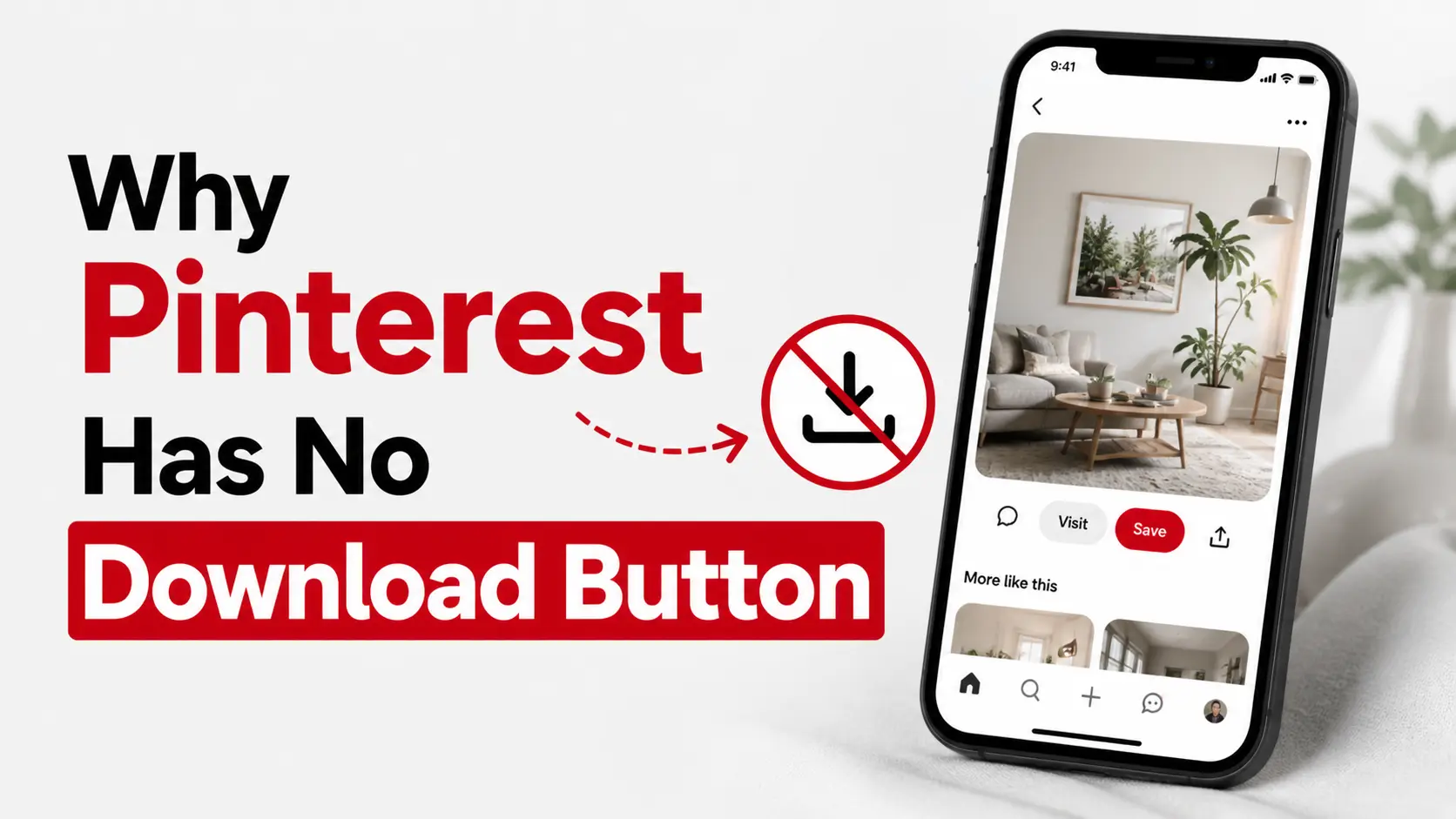
You found the perfect recipe video. Or the design inspiration that exactly matches your project. Or the workout you want to do tomorrow without WiFi.
Then you tap “Save” — and discover Pinterest just added the pin to a board. The actual file? Still locked on Pinterest’s servers, requiring internet and the app every time you want to view it.
If you’ve felt that small spike of frustration, you’re not alone. Pinterest is one of the few major content platforms that has deliberately chosen not to include a download feature. Here’s the real reason why — and what you can do about it.
The Native “Save” Button is Misleading
Let’s clear up a common confusion first. When you tap Save on a Pinterest pin, you’re doing one specific thing: adding a reference to the pin onto one of your Pinterest boards.
You’re not:
- Downloading the video file
- Saving the image to your camera roll
- Copying anything to your device’s storage
- Creating an offline-accessible copy
What you ARE doing: bookmarking the pin’s location on Pinterest’s servers. To view it later, you need internet, an active Pinterest account, and either the app or website open.
This bookmark-style “save” is genuinely useful for organizing inspiration. It’s just not what most users assume “save” means.
Why Pinterest Made This Choice
Pinterest’s product team has never publicly explained the no-download decision in detail, but multiple business reasons clearly drive it:
Reason 1: Engagement metrics matter to advertisers
Pinterest’s revenue comes primarily from advertisers. The platform’s selling point to those advertisers is engagement: pins viewed, pins saved, pins clicked. Every minute users spend inside the Pinterest app is a minute exposed to potential ads.
If users could download videos and watch them offline whenever, Pinterest’s daily active user metrics would drop. Why open Pinterest to watch the recipe video again when it’s already on your phone?
Reason 2: Content ownership disputes
Pinterest has historically had a problem with stolen content. Users repost others’ work, often without credit. If Pinterest officially endorsed downloading by adding a button, they’d be enabling this problem at platform scale and inviting copyright litigation.
By not providing a download option, Pinterest can claim users who download (via third-party tools) are doing so against the platform’s intended use — shifting some legal responsibility back to those users.
Reason 3: Bandwidth costs
Video files are expensive to serve. Pinterest delivers billions of video views monthly. If users could download a video once and rewatch it forever from local storage, Pinterest serves the file fewer times. That sounds good for Pinterest’s bandwidth bill, but it’s bad for engagement metrics — and engagement is what they sell.
The current model — videos must be streamed every time — keeps Pinterest’s servers busy serving the same content repeatedly, which inflates engagement numbers favorably.
Reason 4: Creator retention
Creators choose where to upload based on where their content gets seen and protected. If Pinterest had a public download button, creators worried about content theft might post elsewhere. By keeping downloads “officially” disabled, Pinterest signals creator-friendliness — even though third-party tools make downloads happen anyway.
What “No Download” Actually Means in Practice
Here’s the gap between Pinterest’s stated position and reality:
What Pinterest says: Videos are not downloadable. The save button only adds to boards.
What’s actually true: Every Pinterest video is technically downloadable because it’s stored on Pinterest’s content delivery network (v1.pinimg.com). The browser is already downloading the video to play it — that’s how streaming works. Third-party tools just complete the download as a permanent file instead of a temporary stream.
This isn’t a security flaw. It’s the fundamental nature of web video. Any video that plays in your browser has been downloaded to your computer; the browser just deletes it when you navigate away. Pinterest can’t prevent download — only inconvenience it.
The Workarounds (In Order of Reliability)
Method 1: Browser-Based Downloader Tools (Most Reliable)
A tool like Pin Video Downloader accepts a Pinterest URL, fetches the video file, and gives you the download. No app, no signup, no software install.
Pros: Works on every device, easy to use, no installation, free Cons: Requires the tool’s website to be online and Pinterest’s API to be stable
This is what most people use, and it’s what we’d recommend.
Method 2: Browser Extensions
Chrome, Firefox, and Edge extensions can detect Pinterest video URLs and add a download button directly to the Pinterest interface.
Pros: Convenient (no copy-paste step) Cons: Often break when Pinterest updates the platform; some have privacy concerns about what data they collect
We’re cautious about extensions because they have access to everything you do in your browser. A simple website tool has a smaller security footprint.
Method 3: Screen Recording
QuickTime on Mac, Xbox Game Bar on Windows, or your phone’s built-in screen recorder can capture the video as it plays.
Pros: Always works, even when downloaders fail Cons: Quality is degraded (you’re recording a recording), captures any UI elements on screen, audio sync issues, much larger file sizes
Use this only as a last resort. The quality loss is significant.
Method 4: Developer Tools (Advanced)
If you’re comfortable with browser developer tools, you can find the direct video URL in the Network tab while the video plays. Right-click → Save As gets you the file.
Pros: Free, no third-party tool needed Cons: Tedious, requires technical knowledge, has to be redone for every video
Useful occasionally; impractical for regular downloads.
Method 5: Pinterest’s Own “Download” (When Creators Allow It)
Some Pinterest creators enable a download option on their own pins. When available, you’ll see a download button in the share menu of that specific pin. It saves the video to your device — but with a small Pinterest watermark added.
Pros: Officially sanctioned Cons: Rarely available, adds watermark, only works on specific pins where creators opted in
Worth checking before using a third-party tool, but don’t expect to find it often.
Step-by-Step: Saving Pinterest Videos Without the Native Button
The fastest reliable workflow:
On mobile:
- Open the Pinterest app, find the video
- Tap share icon → tap Copy Link
- Open Safari (iOS) or Chrome (Android)
- Go to a downloader tool, paste the link, tap Download
- The MP4 saves to your device’s Downloads folder
On desktop:
- Open Pinterest in your browser, click into the video pin
- Click the share icon → click Copy Link
- Open a new tab to a downloader tool
- Paste, click Download
- The MP4 saves to your Downloads folder
Total time: 30 seconds.
What About Images? GIFs? Other Content?
Same general approach, with format-specific nuances:
Images: Most browsers’ “Save Image As” gives you a thumbnail (often 564×752 pixels). For full-resolution images (often 1080×1350+), use an image downloader that fetches the /originals/ version.
GIFs: Tricky because Pinterest stores most “GIFs” as MP4 loops. A good downloader tells you the actual format. See our GIF downloader.
Idea Pins (multi-slide): Most downloaders only get the first slide. This is a structural limitation of how Pinterest exposes Idea Pin data, not a tool failure.
Will Pinterest Ever Add a Download Button?
Probably not in the foreseeable future. The reasons that motivate the current restriction (engagement, bandwidth, creator protection) aren’t going away.
What might change:
- Pinterest could add opt-in downloads with watermarks (some pins already have this)
- Creator-tier users might get download permissions for their own content
- A future Pinterest pivot could change the calculus
But a universal download button for all pins, like Twitter or YouTube? Almost certainly not.
Frequently Asked Questions
Is using a downloader against Pinterest’s terms of service?
Pinterest’s Terms of Service prohibit “scraping” content using automated tools. Single-pin downloads via a browser-based tool aren’t typically considered scraping — they’re equivalent to your browser caching a video. However, Pinterest could change interpretation at any time. Use downloaders for personal, occasional use, not industrial-scale collection.
Can I get banned from Pinterest for using a downloader?
Pinterest can’t tell you used a downloader. They can see you visited a pin (just like normal viewing), but they can’t see what happened in your browser tab afterward. Bans for downloading would require Pinterest to track behavior they can’t see.
Why doesn’t Pinterest just remove the watermark option creators can enable?
Some creators want their pins downloadable for legitimate reasons — for example, recipe creators who want their followers to actually be able to follow the recipe offline. Pinterest’s compromise: enable opt-in downloads with watermarks (creator gets credit), keep no-download as the default.
Will browser updates eventually break all downloaders?
Browsers have been gradually tightening cross-origin download rules, which has affected some tools. Reliable downloaders adapt — usually by routing the file through a server so the browser can’t differentiate it from any normal file download. We’ve already done this on Pin Video Downloader, which is why our tool stays reliable.
Are there reasons NOT to download Pinterest videos?
Yes:
- Storage — videos add up. 100 saved videos = 500MB-1GB easily.
- Copyright — saving for personal use is one thing; sharing widely is another.
- Discoverability — saved videos are stuck in your Downloads folder; saved Pinterest boards are searchable, taggable, and shareable.
For some use cases, saving to a Pinterest board is actually more useful than downloading. Don’t download just because you can.
Conclusion
Pinterest’s missing download button isn’t a bug or oversight — it’s a deliberate business decision driven by engagement metrics and creator relationships. But the platform’s video files are stored on a public CDN like every other web video, which means downloading them is technically straightforward, just inconvenienced.
Browser-based downloader tools fill this gap cleanly. They don’t violate Pinterest’s terms when used reasonably, don’t risk your account, and get you the file you actually wanted when you tapped “save.”
If Pinterest changes its position someday and adds a real download button, this guide will become obsolete. Until then, this is how it works.